GRAPE
This is the plugin for GRAPE, based on the following paper: I. Jang, H. Shin, A. Tsourdos, “Anonymous Hedonic Game for Task Allocation in a Large-Scale Multiple Agent System”, IEEE Transactions on Robotics, 34(6), 2018, pp. 1534-1548.
GRAPE is a decentralized algorithm using an anonymous hedonic game framework. Originally developed for ST-MR (Single Task - Multiple Robot) scenarios, GRAPE allows each agent to manage a single task while collaborating with multiple robots. The algorithm seeks to achieve a Nash stable partition, where no agent benefits from unilaterally changing its assigned tasks, thus indicating an agreed-upon task allocation among the swarm.
Based on the original paper, the following enhancements were implemented:
Initial Partitioning Mechanism: For dynamic task generation scenarios, each agent can construct an initial partition where tasks are assigned based on proximity to neighboring agents. This mechanism accelerates convergence to a Nash stable partition in dynamic environments. This mechanism can be also applied during initialization and post-task completion.
Social Inhibition Factor: Although GRAPE was initially designed for ST-MR (Single Task - Multiple Robot) scenarios, it has been adapted for MT-SR (Multiple Task - Single Robot) scenarios by introducing the Social Inhibition factor. This addition penalizes collaboration among agents, encouraging task dispersion and better handling of scenarios where agents need to manage multiple tasks.
An example of the parameters look like as follows:
plugin: plugins.grape.grape.GRAPE
GRAPE:
  cost_weight_factor: 1.0
  social_inhibition_factor: 100
  initialize_partition: Distance # Options: None; Distance
  reinitialize_partition_on_completion: Distance # Options: None; Distance
Parameters
- cost_weight_factor:
Type
Default
Float
1.0
- Description:
This factor is used in the calculation of an agent’s individual utility. The utility is calculated as follows:

where
cost_weight_factorinfluences the weighting factorw_cfor the cost component of the utility function.
- social_inhibition_factor:
Type
Default
Float
100
- Description:
This factor is used in the utility calculation to penalize collaboration. In the above equation,
social_inhibition_factorincreasesf_s, which is the penalty for having more collaborators. This parameter is essential for MT-SR scenarios. However, even with a high value, agents may still collaborate if there are only a few tasks in the vicinity.
- initialize_partition:
Type
Default
String
Distance
- Description:
Determines the method for initializing the partition.
None: Starts with an empty partition.Distance: Each agent creates an initial partition where tasks are assigned based on proximity, with each agent initially taking the task closest to its neighbors.
- reinitialize_partition_on_completion:
Type
Default
String
Distance
- Description:
Defines how the partition is handled upon task completion.
None: No reinitialization is performed.Distance: Reinitializes the partition using the same distance-based mechanism asinitialize_partition, reallocating tasks based on proximity.
Example config.yaml
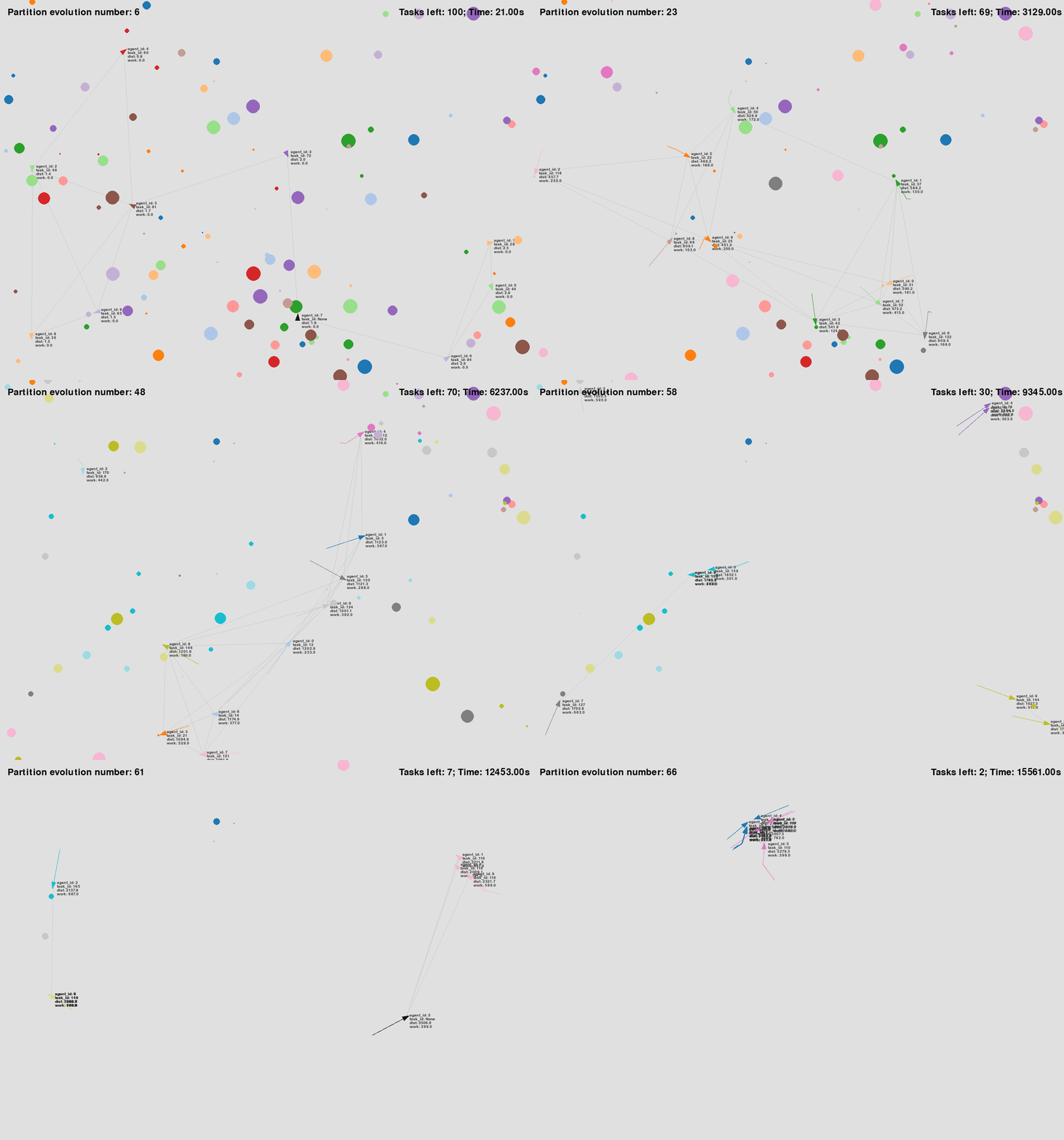
This was executed with the following configuration:
decision_making:
  plugin: plugins.grape.grape.GRAPE
  GRAPE:
    cost_weight_factor: 1.0
    social_inhibition_factor: 100
    initialize_partition: Distance
    reinitialize_partition_on_completion: Distance

agents:
  behavior_tree_xml: default_bt.xml
  quantity: 10
  locations:
    x_min: 0
    x_max: 1400
    y_min: 0
    y_max: 1000
    non_overlap_radius: 0
  max_speed: 0.25
  max_accel: 0.05
  max_angular_speed: 0.25
  target_approaching_radius: 50
  work_rate: 1
  communication_radius: 500
  situation_awareness_radius: 500
  random_exploration_duration: 1000.0

tasks:
  quantity: 100
  locations:
    x_min: 0
    x_max: 1400
    y_min: 0
    y_max: 1000
    non_overlap_radius: 0
  threshold_done_by_arrival: 10.0
  amounts:
    min: 6.0
    max: 60.0
  dynamic_task_generation:
    enabled: True
    interval_seconds: 2000
    max_generations: 3
    tasks_per_generation: 25

simulation:
  sampling_freq: 1.0
  speed_up_factor: 0
  max_simulation_time: 0
  agent_track_size: 400
  screen_width: 1400
  screen_height: 1000
  gif_recording_fps: 0.05
  task_visualisation_factor: 3
  profiling_mode: False
  rendering_mode: Screen
  rendering_options:
    agent_tail: True
    agent_communication_topology: True
    agent_situation_awareness_circle: False
    agent_id: True
    agent_work_done: True
    agent_assigned_task_id: True
    agent_path_to_assigned_tasks: True
    task_id: False
  saving_options:
    output_folder: output
    with_date_subfolder: True
    save_gif: False
    save_timewise_result_csv: True
    save_agentwise_result_csv: True
    save_config_yaml: True
Note
The above example applies GRAPE to the MT-SR scenario. Originally, GRAPE was developed for the ST-MR scenario, and you can refer to Changing Agent/Task Numbers